Intelligent Data Analysis for Google Sheets
Transforming static spreadsheets into conversational intelligence units.
Project Details
- Managed ByOctolade
- Handover
Services
Overview
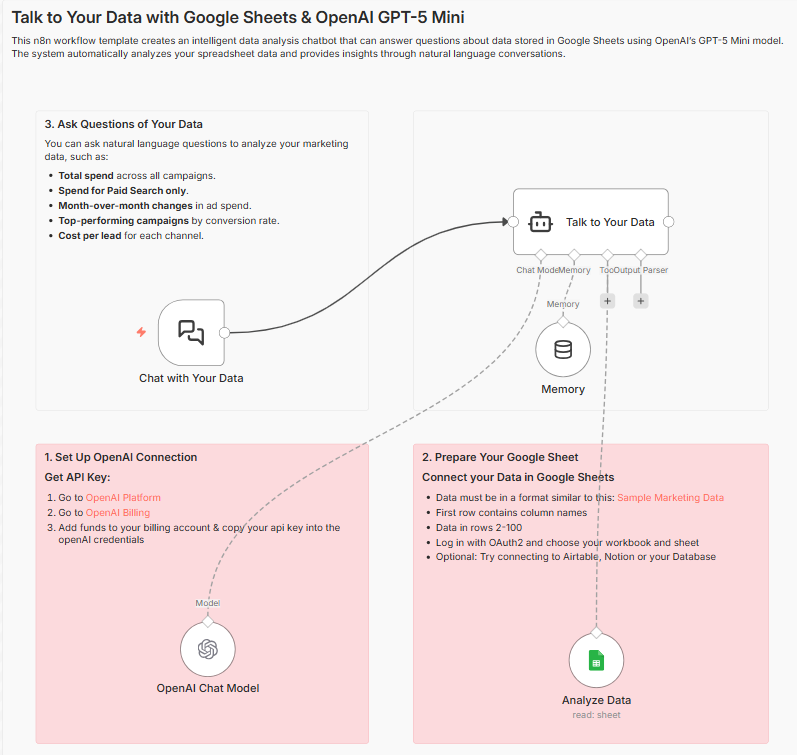
Core Objective: Bridge the gap between complex data storage and actionable insights by allowing users to talk to their spreadsheets using natural language. Tech Stack: Powered by OpenAI GPT-5 Mini, integrated via Make.com with Google Sheets API and a custom Memory Buffer for contextual continuity. Scope: A universal data assistant capable of performing real-time analysis, trend spotting, and reporting without requiring manual formulas or pivot tables.
The Challenge
Data Accessibility: Critical business insights often remain locked in complex spreadsheets, accessible only to those with advanced Excel or SQL skills. Static Reporting: Traditional data analysis is time-consuming and reactive, often requiring manual updates every time a new question arises. Contextual Fragmentation: Standard AI integrations often lack memory, forcing users to re-explain their data structure with every new query.
My Solution
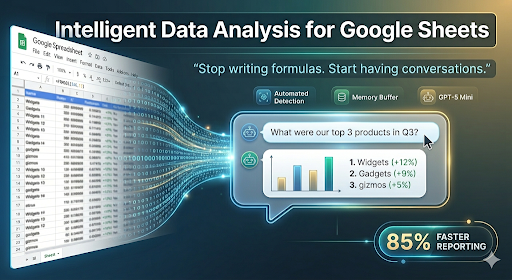
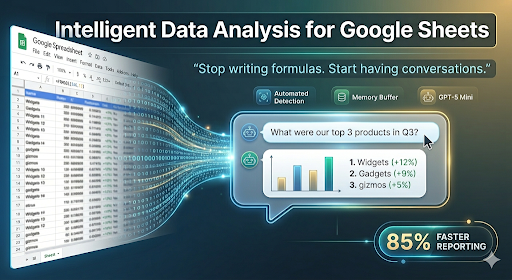
We engineered a sophisticated conversational layer over Google Sheets that utilizes GPT-5 Mini to act as a virtual data scientist. The system features Automated Column Detection, which instantly maps data relationships and schemas the moment a sheet is connected. By implementing a Memory Buffer, the AI maintains a rolling context of the conversation, allowing users to ask complex follow-up questions like 'How does this compare to last month?' without repeating themselves. This workflow transforms every row of data into an interactive knowledge base, providing instant, high-fidelity answers through a simple chat interface.
Results
The automation reduced the time spent on manual data retrieval by 85%, enabling non-technical staff to pull complex reports in seconds rather than hours. Accuracy in data interpretation reached near-human levels, with the AI successfully identifying trends and anomalies that previously went unnoticed. By democratizing data access, the organization saw a significant uptick in data-driven decision-making across all departments, from sales forecasting to inventory management.